






Julion P. T. Okram Weaves Mystery, Romance, and Science Into Thrilling Tales
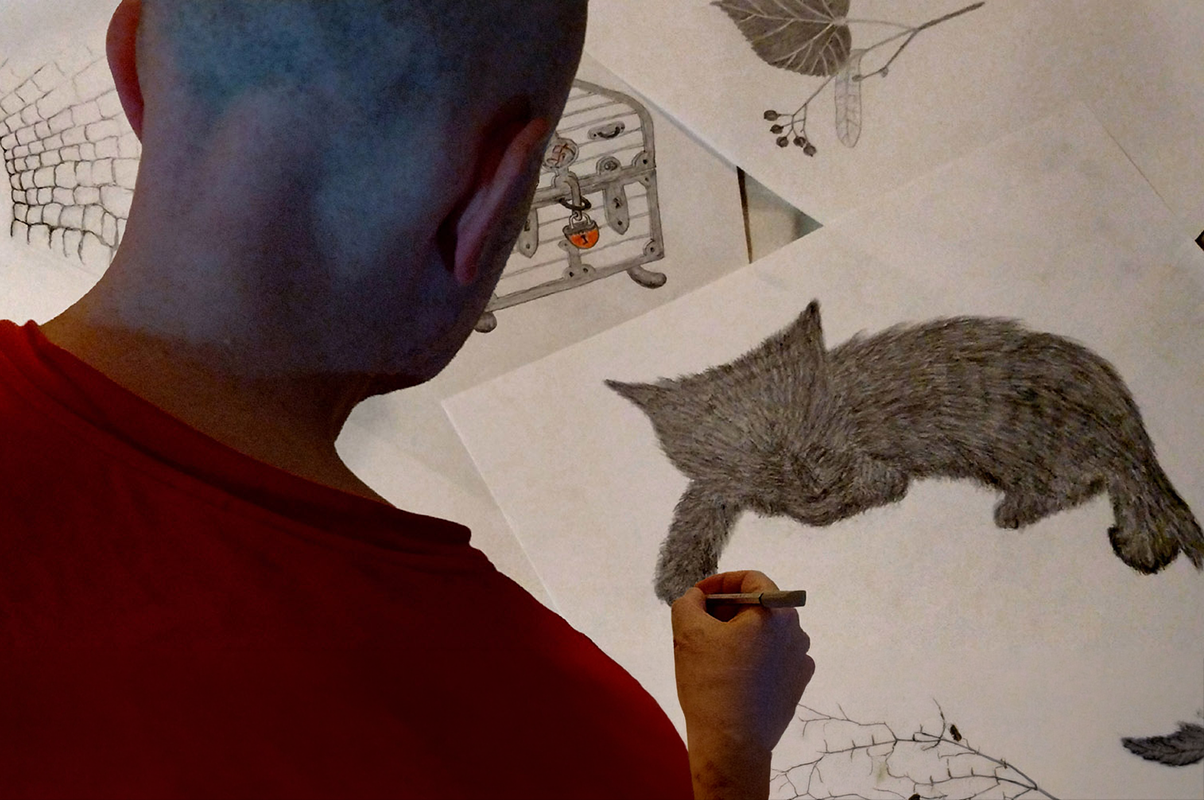
Photo: Julion Okram working on new drawings – A peek over the artist’s shoulder
The Enigmatic Author Redefining Romantic Mystery Fiction
Julion P. T. Okram’s works blend scientific intrigue with human emotion, crafting enthralling tales rich in intellectual depth, suspense, and romance. His unique approach captivates and challenges readers around the world.
Julion P. T. Okram is a rare blend of scientific curiosity and literary finesse, a writer who transcends conventional boundaries to craft deeply introspective yet gripping tales. His works inhabit the elusive space between fact and imagination, teetering on the edge of possibility while grounding themselves in the soul’s great universal questions. With themes spanning romance, suspense, and the eternal mystery of existence, Okram’s fiction is anything but ordinary. His vivid imagery and intellectual depth create an irresistible pull for readers who crave thought-provoking stories wrapped in the familiar thrill of discovery.
The author’s Expedition to Cursed Forest trilogy exemplifies this unique intersection, conjuring a world steeped in awe and trepidation. Is it myth, science, or pure fiction? Only those who dare to immerse themselves in the story’s intricacies will uncover the truth. And yet, this is no mere exercise in escapism; Okram’s “mystery dramas” invite readers to ponder the intersections of philosophy, ethics, and scientific innovation in ways both accessible and profound. Whether conjuring the enigmas of distant, verdant forests or the emotional labyrinths of human relationships, his evocative narratives linger in the mind long after the final page.
Yet what truly sets Okram apart is his steadfast devotion to readers’ intellectual and emotional engagement. In a world driven by shallow connectivity, he cultivates a private yet communal reading experience — one centred on trust, curiosity, and the joy of unraveling secrets without intrusion. His choice to shun conventional publishing norms in favour of exclusivity fosters a deeper, almost conspiratorial bond between author and audience. For Okram, storytelling is not merely about entertainment but about building bridges between disparate worlds, ideas, and, most importantly, people.
Few authors today exhibit such mastery of suspense, humour, and romance — nor wield them so deftly to craft tales that challenge, amuse, and enlighten. With a voice as enigmatic as his plots, and a perspective shaped by his multicultural roots and scientific penchant, Okram promises literary adventures that defy the ordinary. His stories remind us that the greatest mysteries lie not only in the unknown but also in our longing to understand it.
A masterful storyteller who balances scientific curiosity with vibrant human emotion, creating spellbinding narratives both enlightening and entertaining.
Countless writers borrow from science; few let science borrow from them. Your mysteries and their solutions often weave between empirically proven shockers and scientific imagination. How do you decide when an astonishing concept should stay in the lab — and when it deserves a place in fiction?
Take my Mom: It’s hardly imaginable to catch her reading a scholarly treatise on recent advancements in reproductive endocrinology. Nonsense. But she would avidly devour a romantically tinted drama of a nunnery opinionally divided over the acceptable borderlines for their sisterly assistances with intimate marital functions. What?? Am I concocting an absurdly cheapish, kitschy subplot fabricated to shock the readers? Not at all. Imagine one wing of abbesses intricately scheming against another to subvert their monastery’s recent involvement in a hormone donation program helping infertile couples. As if this wasn’t enough, one of the oppressed nuns had joined the convent years ago because of her unfulfilled platonic crush. All her purposely drowned feelings for an unaware “straight” young woman painfully revive when her idol accidentally appears among the recipients of an experimental infertility treatment based on those jeopardised monasterial protein collections…
See? The same biomedical matter can be conveyed in two principally divergent styles aimed at two utterly unalike audiences: Highly specialised physicians primarily rely on dryly dissective case reports and rigorous studies in expert journals, while their layman patients mostly gravitate towards the same topics reflected in momentary memes and sensational melodramas. That’s where an elucidative, charismatically crafted dramystery can step into play to bridge the viewpoints of both groups. Everybody feels relieved when abysmal chasms between disparate worldviews fade away, when the purifying effects of a resolved fictional predicament uplift our spirits longing for a soothing closure. As a big win-win result, the originally divisive and seemingly irreconcilable controversies gradually lose their stinginess until they start to caress our minds towards a liberating convergence in a mutual understanding.
Hence, the answer to your question: It’s the scientific conundrums of life-changing calibres that are inherently predestined to leave a deep mark in fiction.
What’s your trick behind reshaping sterile scholastic discourses into entertainingly appealing tales?
In the academic world, useless research typically attracts little or no acclaim — meaning no follow-up experiments by others, no citations in others’ studies. The world of “belles-lettres” is similarly rejective, especially towards long novels if they are boring. The opposite spectrum is occupied by influential writers who evoke our positive emotions by locking us into their universes through our own curiosity.
How can the above observations materialise in discovery-inspired mysteramas? For example, my trilogy titled Expedition to Cursed Forest dispels dullness by introducing a paradisal world concealed behind a scary barrier of dangerous plants and beastly behaving animals. This is the turning point when critical readers start to wonder whether anything like this is even remotely possible — the curveball supercharging the hair-raising plotline that makes you palpably feel the fragile membrane between “what is” and “what if”. Could we engineer such a heavenly microcosmos if we combined all current biological discoveries? Or are the woodland areas beyond the boondocks around the village of Dunkirk Respites a local remnant of the mythical Eden, a living scientific proof of the long-bygone biblical paradise? Or is it something else? Angelic or evil? Are the creatures there diseaseless and immortal? Search engines and chatterbots will not help you with figuring this out — the only way is to hold your breath and enter the world of thrilling twists and turns of events…
To sum up the above reflections, many front seats on the page-turner flagship are reserved for reality-aware yet still breathtakingly enthralling cliffhangers. Particularly charming are those that soundly address the pressing dilemmas of contemporary society or that grapple with the ever-resurfacing eternal questions. My serial “cosy nail-biters” are studiously but accessibly rooted in both mentioned themes — while also remaining entertaining and, not infrequently, rib-tickling.
Balancing humour with suspense and romance can be challenging. How do you ensure that the additive ingredients enhance rather than disrupt the mystery?
Nothing can easily compromise an entrancing mystery once it gets detected by mystery-craving readers. Especially not when funny, romanticising, philosophical, and educational moments are blending in like refreshing sprinkles of precious spices.
One clarification is needed here, though: There can be intergenerational differences in expectations for romance. It’s ubiquitously trendy to reduce the connotation of romantic to mere “pre-erotic and erotic affections”. I have met young people who had no idea this word can also encompass so much more: dreamful idealism, positivistic transformation of our environments, heroism, rich inner life, friendship, devotion, passion, picturesque sceneries, pleasant households and manors, spirited lifestyles — and of course love in all its meanings, permutations and depths. Buckle up, the full-fledged romanticism is back!
In your quote about “trying dying” versus “dying trying,” you touch on a tension that seems both timeless and urgently contemporary: Humans have always sought ways to extend life, understand death, or leave a lasting legacy, whether through rituals, reflection, divine intervention, or scientific discovery. If you could convene a conversation — a “multi-logue” as you often say — across cultures, philosophies, and minds of spiritualists, pragmatists, and skeptics, how would you frame the question of immortality, longevity, or the meaning of a life fully lived? What do you hope such a discussion would reveal about what unites humanity in our shared curiosity, courage, and care for future generations?
Now you’ve got me: There is a firehose of unanswered questions constantly taking turns in retesting my mind — each of them more unfathomable than another. The real question is: Can the world’s brainiest thinkers as a whole, armed with artificial intelligence, perceive themselves to be more than sheer half-flummoxed observers of the Universe? Allow me to doubt that. But the draft ultimate takeaway from such plenary cross-talks could be something like this: Question everything, discover everything, or perhaps even bioengineer your future if you must — but what you should care about above all is staying a whole-hearted person contributing to an enlightened, tolerant humankind.
Many of your openings hinge on an odd situation or a single curious detail that unfurls into a much weirder, full-blown puzzler. For example, the cover of “The Mystery of the Rammed Key” shows a seemingly mundane object, namely a weatherworn key, in a perplexingly dumbfounding context — it is half-embedded in a tree. Those anomalies then serve as the catalysts for extraordinary events. How do you come up with such brain-teasing ideas?
Believe it or not, it’s everyday life itself that mastercrafts the most wondrous braintwisters imaginable. And believe it or not, climbing a robust linden and spotting a blackened old key high in its crown was one of the most cerebrally ignitive moments of my own childhood. Observant onlookers can tackle similar encounters either scientifically or artistically, or both. That’s all. Add a smidgen of inventiveness and yearfuls of hard investigative toil, and you will be remodelled into an inquisitive scientist, an inspiriting artist, or both.
Speaking of your captivating illustrations and distinct book covers: How important are they to your storytelling?
Imagine modern investigators unearthing a strange old tape that does not fit into any electronic device known to forensic experts. What devilish evidence could be recorded on it?? Their jaws drop when they visit our old friend, mysteriologist Dr. Barton, with all his unheard-of gizmos and gadgets. As he pulls out a trolley loaded with some ancient-looking thingummy apparatus, all mystery-lovers must freeze, thrilled to see what’s so nonplussing about it. Today’s readers may be clueless about what the British TELCAN was in the 1960s. But this cluelessness will serve to their benefit. Why? Because they will vividly relive the abovementioned investigators’ bemusement — on their own skin — after reaching my timely illustration (especially the animated version with the spools working…). Yes, some e-reading versions of “Okrambooks” show motion pictures to draw you deeper into their enigmative fluidum. It’s a special bonus added as a reward for the appreciators of precious moments with a book in their hands.
Audiobook listeners and the visually impaired, don’t despair! You may crawl under your warmy duvet or close your eyes in your supercosy recliner — and still not miss out much: Apart from handheld e-book players capable of reading aloud, there are screen readers that can conveniently vocalise the depictive narrations embedded in the images’ metadata. Also, AI tools are getting increasingly better at interpreting images, literally with every passing heartbeat.
Another facet of picturisation is that explicative storyline visuals bring us a leap closer to a movie-grade experience — whether in fans’ cinematically imaginative minds or when adapting the plots for screenplays (which, as you can guess, is an exciting plan under recent consideration).
It’s quite unusual to write every book across multiple languages. What’s in for readers who cannot read all those lingo versions because they only understand English or a single other language?
Oh, let’s not call it multiple. To be precise, it’s four linguistic systems used fluently, plus small first-hand nuances contributed to selected translations. And there is absolutely no need to read beyond your mother tongue — because each author-polished book feels as though it was written in a single vernacular. Such quality would be almost impossible to achieve if two or more translators were to conflict over a single text.
What additional gains does this multilinguality bring to readers? There is an old aphorism that hyperbolically states “To have another language is to possess another soul.”. Tailored to humans, this saying feels highly figurative — but nation-specific book versions often “live their own fates”. The author-controlled balance between idiomatic naturality and the desired impression-building undercurrents is a unique opportunity to cultivate finely nuanced local-patriotic magicality on a multinational scale.
For example, parts constructed in English are based on extensive life-and-work experiences in the USA, which makes depicting adventures on American soil far more authentic than translations. On the other hand, pedigree roots inside and outside the Iron Curtain together with language skills in that cross-European geopolitical context add surgical precision to sentiments around forcedly split families, secret dissident resistance movements, desperate emigrations, and the overall tragicomicality of the Cold War period on the opposite shores of the Atlantic – on the Old Continent (that’s when and where my centuries-spanning book series starts).
An illustrative embodiment of these multicultural interplays is the main adult protagonist, publicly known as Dr. Barton, who studied in France and the UK and then got stuck in the communist Eastern Bloc. It would be an unforgivable ruiner to reveal more details about the sidesplitting anecdotes this hero’s transnational life path causes — not only before the wave of European anti-communist revolutions but also after the formation of the EU. Who this Barton guy really is, I shall not disclose here either. Brace for another layer of mysteriality and unforeseen amusement!
You distribute your work more often through password-protected, peer-to-peer recommendations than via common channels. In what ways has that unostentatious, invitation-prioritising model reshaped the kinds of secrets you are willing to inweave into your plots?
Friend-to-friend endorsements among like-minded bookmates ensure my stories reach the right readership directly, without the need to randomly cast a wide net to the broadest masses. This breaks me free from cliched templates of commonplace bestsellers that are premeditatedly algorithmised to seek wide commercial attention. Instead, I can elevate the intellectual benchmark, include unheard-of mind-bogglers, and refocus on honing enigmatological gems to a perfection worthy of an above-average fanbase.
Your book-sharing circles are sometimes perceived as a secret society in and of themselves. Does this hurt or improve your reputation as an author?
Frankly, I don’t know. Since I have never tested conventional distribution stereotypes, it is impossible to make numerical comparisons of popularity.
What’s for sure is that the little aureole of Sherlockian enigmatism stimulatingly matches the taste of mystery lovers. Can there be an overriding motivator for a thriller-smith to abandon such an enticing gateway and switch to spreading his writings through impersonal, mass-processing venues? I didn’t find one.
Side benefits of my mystery-themed protective layer include custom-tailored licensing designed to thwart piracy; shielding against AI crawlers harvesting accessible content to train modules capable of impersonating the affected authors’ writing style; and invisibility of endgames and finales to web-indexing robots, which then cannot show spoilers in search results. Even more importantly, readers are not spied on. Sure, their registration e-mails are collected, but I have no way of knowing who is behind any given inbox. My websites cannot “see” which other sites my readers visit or what else they read — and vice versa, socialising platforms that constantly profile their users cannot detect who is reading my standalone books circulating beyond their intrusive reach.
So yes, there is a certain well-fitting and very opportune aura of secrecy. Apart from that, everybody keeps their own secrets private, and nobody joins any Freemasonic lodge or whatever — you don’t even need to participate in any discussions if all you want is to read. The fact that your activities do not automatically leak to chatrooms or profile feeds does not mean you are conspiring in a covert brotherhood. In other words, no cults, fraternities, clans, leagues — just a lightly innovative privacy-oriented booksie website that makes access to proprietary copyright-protected contents both exclusive and communal.
But then, given today’s digital landscape full of fierce competition in attention-grabbing techniques, how do you build and maintain meaningful engagement with your readers beyond your books?
I don’t. There is no active effort to routinely keep in touch with fans on a personal level. Surprised? Don’t be. It would feel inexcusably unfair to encourage massive networking and then be underresponsive, shallow, or hide behind automated AI chatbots.
But of course, direct contact is possible: I do my best to respond to all noteworthy readers’ entries in the book-specific feedback forms. Rest assured, your book club’s chat invitation will not be declined if the distance or technical means allow for in-person or virtual participation (and I also support book clubs by giving away free books). Intelligent interview proposals are accepted whenever the workload can be paused for a little while.
Such interactions can consume a great deal of time. In contrast, my primary objective is to satisfy the fandom with new continuations of their beloved series rather than divert their absorption towards pointless stalking of their author.
Subject-wise, my preference is to not overstep beyond book-related debates: The Internet should be a comfortable place for everyone, readers and authors included, with books providing an excellent opportunity to slow down and decompress. My credo is to regard literary worlds as safe harbours for our souls, no strings attached — no social media chases, no hidden personal agendas behind, no political aspirations or propaganda, no trolling, no flirting side-plans, no advertising mega-chains hooked in, no cookie minefields and user-tracking nightmares deployed — just an online nook dedicated to plain simple books-reading delight and mutual civility.