











Tallinn Beyond the Medieval Postcard
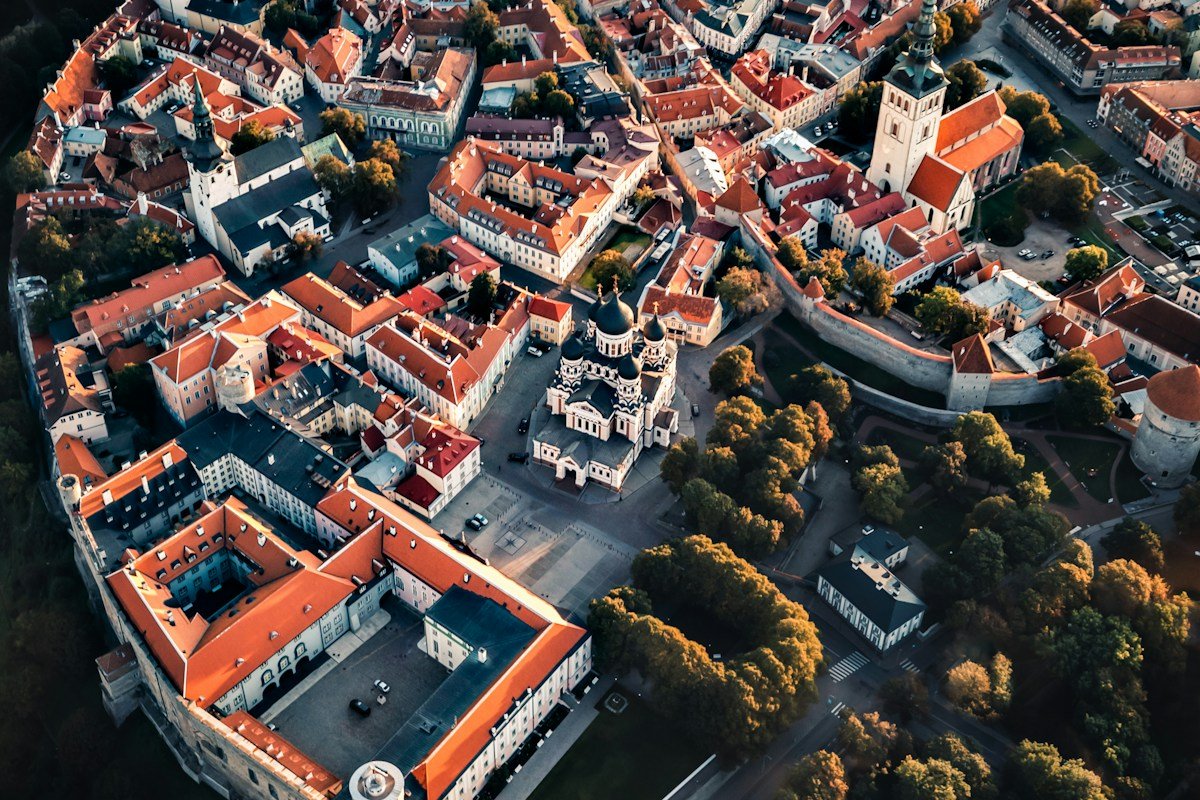 Aerial view of red roofs and church spires in Tallinn Old Town. Photo by Filippo Cesarini.
Estonia’s historic capital offers an unusually clear street pattern, where the legacy of trade can be read in the shape of the old town.
Tallinn’s old town makes a strong first impression from above. Red roofs gather beneath church spires, and the pattern seems compact enough to understand at once. At street level, that apparent simplicity gives way to a more rewarding collection of routes, boundaries and changes in scale.
UNESCO identifies the historic centre as an exceptionally well-preserved example of a northern European trading city. Its medieval structure of streets, squares and building plots remains particularly important. The heritage is therefore found as much in how the town fits together as in the appearance of individual facades.
A useful approach is to walk without immediately seeking the next landmark. Notice where a street narrows, how a square gathers adjoining routes and what can be seen across the roofline. These relationships help explain a place built around exchange. The old town becomes an urban system rather than a sequence of decorative stops.
Give interior visits the same selectivity. One building explored with care can be more informative than several entered briefly. Read the interpretation, look at the materials and consider the activities for which the spaces were designed. A historic city is easier to remember when a few discoveries have depth.
Tallinn also deserves to be encountered as part of contemporary Estonia. Leave time beyond the most photographed lanes, and avoid expecting daily life to resemble a medieval tableau. Preservation has value because it carries history into the present. The most satisfying visit connects those periods, allowing the old town’s coherent form to become the beginning of a conversation about the city rather than the end of it.
Further reading: UNESCO World Heritage Centre.
Photo by Filippo Cesarini.