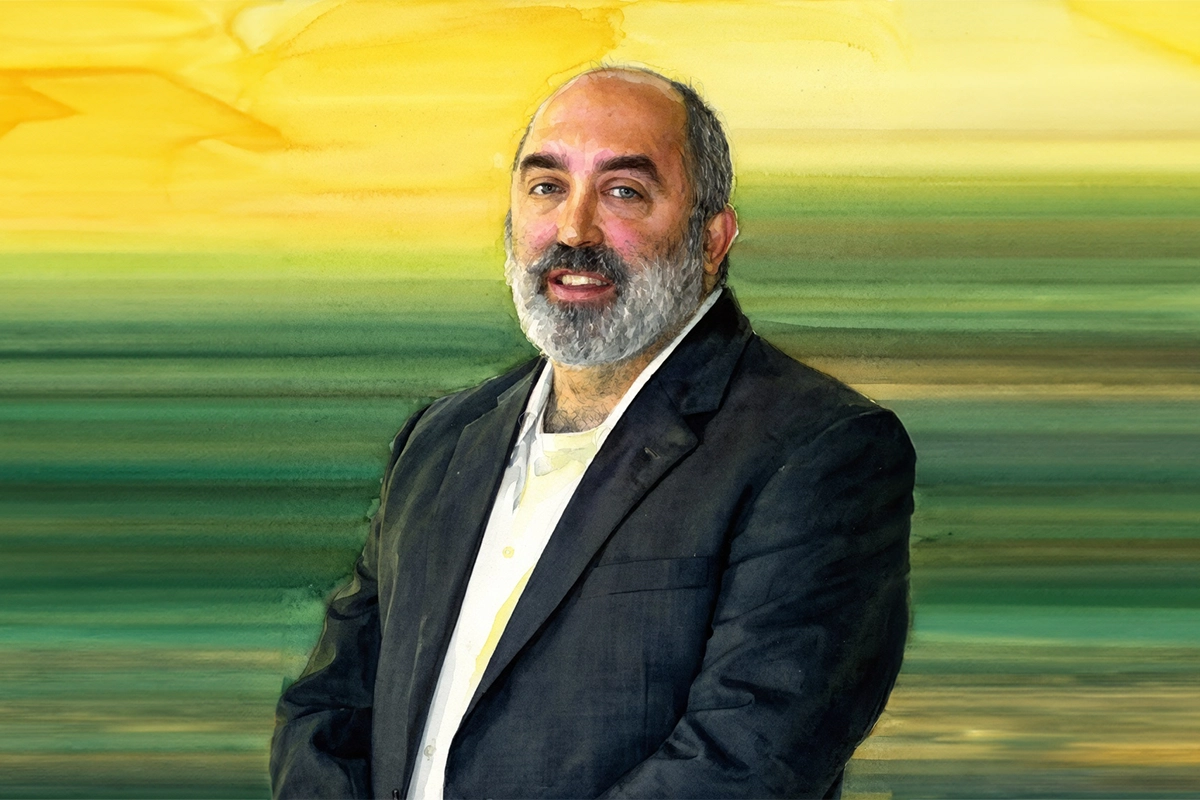






Dave Niemitz Weaves Magic And Morality Into Captivating Worlds
Discover The Genius Behind Guild Mage
Dave Niemitz discusses his creative process, inspirations from medieval tales, moral complexity in his characters, the evolution of his writing journey, and insights into the challenges of modern publishing.
D ave Niemitz’s storytelling prowess establishes him as a cornerstone within the modern fantasy literary landscape, a talent Mosaic Digest is truly honored to feature in our latest issue. With a distinctive flair for blending traditional folklore and innovative world-building, Niemitz has crafted compelling tales that captivate fans and critics alike. His fantasy series, The Faerie Knight, has redefined epic narrative structures with its rich medieval influences and intricate magical systems, while his latest work, Guild Mage, breathes life into a linguistically complex and vividly realized magical world.
What sets Niemitz apart is his ability to intertwine disciplined creativity with raw emotion, anchoring his works with morally intricate characters who confront challenges as relatable as they are fantastical. His commitment to engaging with readers, whether on platforms like Patreon or Royal Road, has cultivated a loyal and ever-growing community that eagerly anticipates his next literary endeavor.
In this exclusive Mosaic Digest interview, Niemitz offers a rare glimpse behind the curtain of his richly imagined universes, sharing his inspirations, methods of balancing a dual career as a writer and teacher, and advice for emerging authors in a rapidly evolving publishing world. Whether you’re a long-time fan of The Faerie Knight’s chivalric elegance or a newcomer enchanted by the magic of Guild Mage, this is a conversation that promises to inspire and illuminate.
Your fantasy series, The Faerie Knight, has captivated readers. What inspired you to create this intricate world?
The Faerie Knight series was inspired in equal parts by medieval romances, such as the stories of Arthur and the Song of Roland, and by the British Romantics, particularly Keats’ La Belle Dame Sans Merci and Byron’s Darkness. As the writing went forward, of course, I ended up folding in more influences, such as the Goetia, Wieland’s Oberon, L. Frank Baum’s Oz books, and the writings of Roger Lamb. I deliberately worked to write dialogue – particularly in the case of Trist, the protagonist – in an elevated style, to reflect the sort of ideal that knights should be polite and eloquent, which we see in works such as Gawain and the Green Knight. Visually, two museums in New York City helped me to establish a tone: The Cloisters, and then at the MET, some of the stained glass pieces they have on display, as well as the hall of armor.
In your novels, magic systems play a pivotal role. How do you approach world-building to ensure consistency and immersion?
When it comes to magic, I have to make something that makes sense to me. It has to come from somewhere, because even within a fantasy world, I want internal consistency. And so in the case of Faerie Knight, I played with this concept of faeries essentially being predators that fed on souls, and that in return for a Tithe of souls – like the mythical Faerie Tithe to Hell – he would be given a portion of power to carry out the tasks of the faerie court. Humans are not, in this world, people who have access to magic by default: it must come from somewhere else. That could be a faerie, a daemon, or one of the angelus. I played off the old idea that faeries were the angels who had refused to take sides during Lucifer’s rebellion, and thus been condemned to the mortal world.
In my newest series, Guild Mage, I went in a different direction. I wanted to play with the idea of a language of magic. So often we see magical incantations, but rarely do I feel like authors really dive into that. So I started with Indo-European roots, set myself spelling rules, and then grabbed conjugation charts from latin. Once I had a set of guidelines for myself, I could tell a story about a Liv, girl who has to conjugate her words of magic, use the right cases, and figure out how to say what she wants to happen in a half-forgotten, dead language.
Your characters often face moral dilemmas. How do you develop such complex personalities and their evolving arcs?
I try to listen to what my characters tell me. I feel like, if you aren’t discovering things as you go, where’s the fun in writing? So the ending I had originally envisioned for my first novel, A Sea Cold and Deep, ended up not happening, because the characters wouldn’t do that. The ending that we got instead came directly from how the two main characters, Annie and Kaito, had made choices and grown over the course of the story. I just finished drafting the final chapter of what will be the sixth volume in the Guild Mage series, and I can tell you that Liv made a fairly significant choice, one that not all of the people she cares about will agree with. It’s not something I knew would happen when I wrote the first volume, but it’s consistent with the themes I wanted to explore, and it made sense for her.
As a teacher and writer, how do you balance these two demanding roles?
My writing process has evolved over time. When I began, I tried to set myself a goal of writing 500 words a day. By the end of Faerie Knight, I was writing two thousand. With Guild Mage, I’ve been writing three thousand the entire way through. I make the commitment to doing that five days a week, Monday through Friday, and resting or working on revision during the weekend.
Your debut novel, Guild Mage: Apprentice, received notable attention. How did that success influence your subsequent works?
I’ve been incredibly happy with the reception the Guild Mage series has received so far, and I’m very pleased to be working with Mango Media and Podium Entertainment for the release. The initial reception on Royal Road led directly into signing with those publishers, and it means that I can continue writing in this world. If not for this initial success, we wouldn’t have volume two scheduled to come out this autumn, for instance. And of course, during this process, I’ve met wonderful people whose experience I’ve been able to learn from.
Audiobook versions of your novels have been well-received. What was your experience in adapting your work for this medium?
I feel like I’ve been incredibly lucky in the voice actors who have tackled my material, from Kristin James and Fajer Al-Kaisi on Guild Mage, to Richard Trinder with The Faerie Knight. It’s a whole different experience to hear such talented people interpret my writing, and I’m very grateful. It has taught me that I need to think about pronunciation, particularly when writing within the fantasy genre! Podium, for instance, sends me this spreadsheet to fill out with the pronunciation of all the character names and magic words.
You maintain an active presence on platforms like Patreon and Goodreads. How important is community engagement to you as an author?
Incredibly important. During the Guild Mage release, we had something like thirteen thousand views on the release thread over at r/ProgressionFantasy. That’s a huge amount of eyes on a new novel, and it makes a big difference. And then, of course, we had nearly seven thousand followers on Royal Road, and they were instrumental in making for a successful release. Everyone who bought a paperback to put on their shelf, or decided to give our audiobooks a listen, helped make this happen. I’m not someone who is naturally good at social media, so it’s sometimes a struggle for me, but for a new author it’s vital.
Given your background in creative writing, how has formal education shaped your writing style and discipline?
There are tips or tricks, ways of thinking or editing, from professors I haven’t talked to in fifteen years, that I still keep in mind when I’m writing. One of my undergraduate creative writing teachers at CCSU, for instance, used to read us passages from the absolute worst romance novel he had ever found. And then once we’d all finished laughing and gasping for breath, we’d talk about what was wrong on a very specific level. Then again at Fairleigh Dickinson, the idea that you could change up the way you wrote when you got stuck – that you don’t need to write scenes in order, for instance, you can go back later and add the connecting material. That was very liberating, to be almost given permission in that way.
Looking ahead, what themes or genres are you eager to explore in your future projects?
I want to get back to science fiction eventually, but first I want to follow up on the success I’ve had writing fantasy. I’m working out ideas for a new series, for once I get within sight of the ending of the Guild Mage books, and I’ve just reread Gilgamesh to begin pulling out things specific to that time and place. What kinds of foods did people eat in ancient mesopotamia? What kinds of cloth did they have, what might their cities have smelled like? I also picked up a copy of Assyria, by Eckart Frahm, and Flame and Crimson, by Brian Murphy, which is a history of the development of sword and sorcery as a genre.
What advice would you offer to emerging authors navigating the challenges of the modern literary landscape?
If you are willing to work hard, we are living in a window of perhaps the most democratized publishing landscape in decades. Authors are making a living self publishing through Kindle Unlimited, or writing serials with a strong base of Patreon Subscribers. People like Matt Dinniman, with his Dungeon Crawler Carl series, are breaking through into traditional publishing through non-traditional routes. I don’t think anyone can say for certain how long the current publishing environment will last, but it’s a remarkable time, especially for serial fiction. I don’t think we’ve seen such vibrant communities of authors and readers interacting around serial stories since people like Robert Howard and H.P. Lovecraft were publishing in Weird Tales back in the thirties.