










Quito Gives the Historic City a Mountain Setting
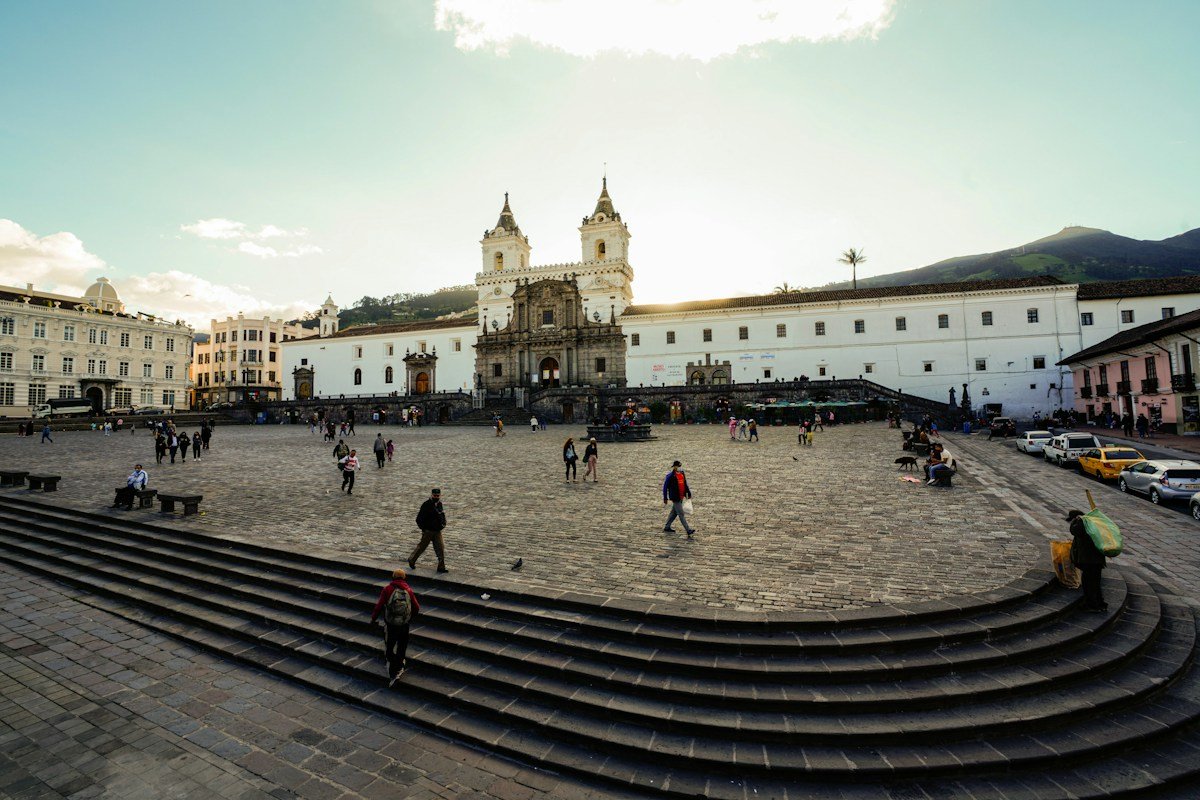 People crossing a broad square before a white church in Quito. Photo by Andres Medina.
Ecuador’s capital brings Andean topography and a rich architectural inheritance into close conversation, rewarding a measured approach on foot.
Quito’s setting refuses to stay in the background. Hills and mountain slopes shape the sense of distance, while the historic centre concentrates attention on squares, churches and the spaces between them. The city can feel expansive and intimate within the same walk.
Founded by the Spanish in the sixteenth century on the remains of an Inca city, Quito preserves an important historic ensemble. UNESCO highlights its architecture and the artistic traditions of the Quito school, in which indigenous and European influences came together. That combination is a stronger starting point than a description of the centre as simply colonial.
Choose a small area and examine it properly. A church interior, a square and the adjoining streets can sustain a morning when there is time to consider materials, craft and urban arrangement. Monumental buildings matter, but so do the more restrained structures around them. Together they establish the city’s scale.
The Andean setting also argues for a gentle rhythm, particularly on arrival. Avoid turning the first day into a test of endurance. Allow time to sit, orientate and adjust plans to how the day feels. The view from a square is not improved by being too hurried to notice it.
For Mosaic Digest’s culturally curious reader, Quito raises a useful question about how inherited forms become local. Buildings and artworks carry evidence of unequal colonial encounters, but also of skill and adaptation by the people who made them. Looking for those layers produces a richer visit than collecting spectacular interiors. Here, the mountains frame a city whose artistic history deserves equally careful attention.
Further reading: UNESCO World Heritage Centre.
Photo by Andres Medina.