












Across the Atlantic in 6.5 Metres, a Belgian Sailor Chases Another Record
Racing The Atlantic
Belgian sailor Quentin Debois is preparing to race solo from New York to England in a Mini 6.50, chasing a North Atlantic record of 17 days and nine hours.
Belgian sailor Quentin Debois hopes to make waves in yet another world record attempt.
He is already the first Belgian to set the record for a solo east-to-west crossing of the Atlantic.
As soon as weather conditions are favourable, Debois will splash out on his latest adventure.
He will set sail from New York to attempt a second challenge even more ambitious than the first: to break the record for the solo west-to-east crossing of the North Atlantic in a Mini 6.50.
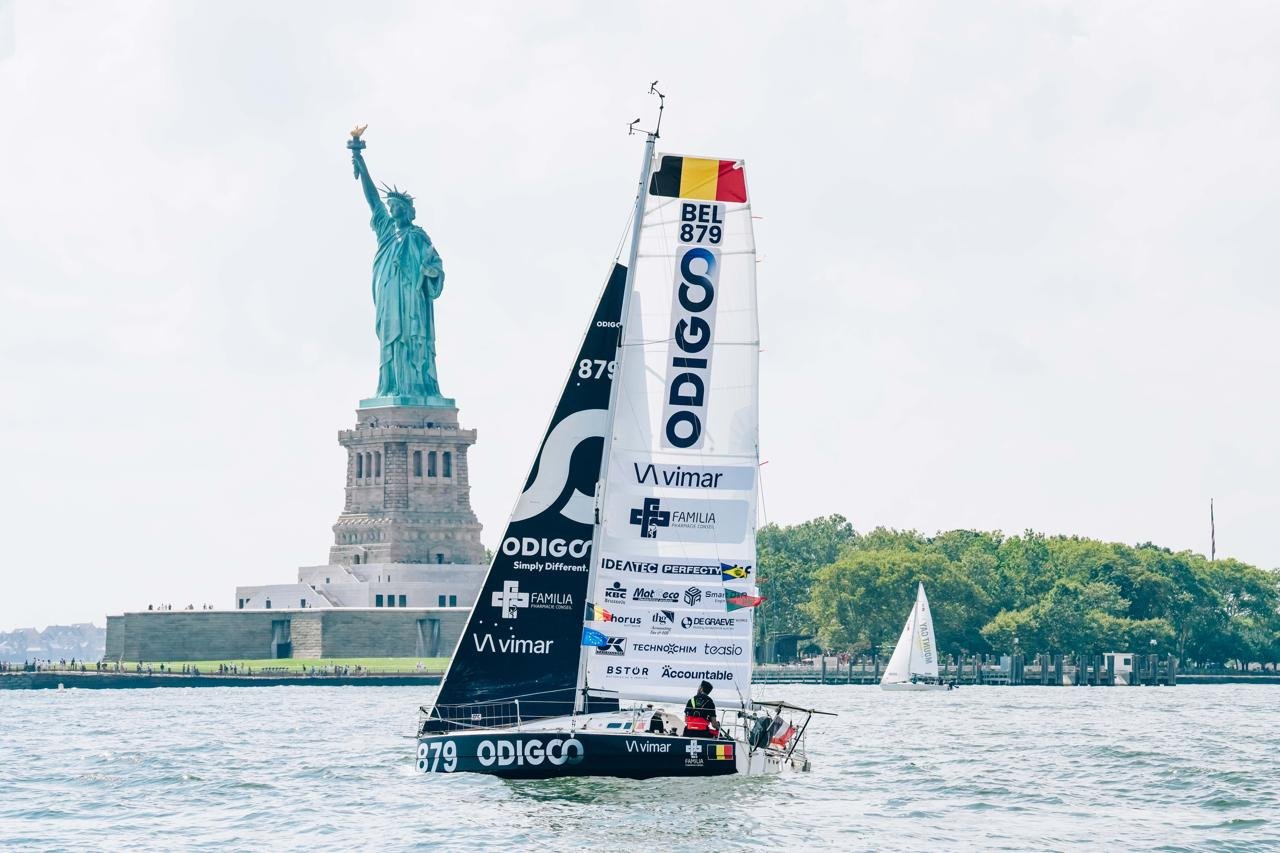
This is a high-performance, single-handed ocean racing sailboat measuring exactly 6.50 meters (21.4 feet) long. It is the smallest racing boat in the world.
He aims to cover the 5,300 km separating New York from Lizard Point in England.
The record has been held since 2023 by American Jay Thompson, who set a benchmark time at 17 days, 9 hours and 57 minutes.
To surpass this, Debois says “teamwork will once again be key, combining rigorous technical preparation, precise route planning and highly adaptive navigation in demanding weather conditions, from one low-pressure system to the next.”
Two sailors have, in fact, successfully completed a solo crossing of the North Atlantic in a Mini 6.50: David Allamelou (France) in 2018 and Thompson.
Debois travelled to Lockwood Boat Works in South Amboy, south of New York, to prepare his boat.
He says that every component, “from the smallest to the largest,” had to be inspected and reinforced to ensure the Mini 6.50 could “withstand the significant and repeated stresses of sailing across the North Atlantic.”
The boat will be “pushed to its limits non-stop”, he says, adding, “The North Atlantic is a demanding arena: you have to contend with shifting weather systems, strong winds and more challenging conditions.”
“To break the record strategy will be crucial. Working closely with my route planner Basile Rochut, I’ll need to make the most of the North Atlantic low-pressure systems, constantly adjusting my course to ride one weather system after another.
“The aim will be to stay as close as possible to a cold front – to the south of a low-pressure system – for as long as possible.
“This is a demanding strategy for the boat, involving stronger winds and rougher seas.
“The next aim will be to position myself to the north of the Azores High to reach the English coast. To succeed in this challenge, the boat’s technical preparation and route planning are crucial.”
Several parts of the boat have been reinforced and repaired.
The most significant repair involved the hull and the reinforcement of its structure. A considerable number of deck fittings – equipment and small mechanical parts used to manoeuvre the boat – have been replaced.
To ensure greater safety for the boat on a route heavily used by cargo ships, a new AIS antenna – longer than the previous one – has been fitted at the top of the mast.
This ‘shared radar’ system enables boats to automatically signal their presence to one another.
The 6.50 will now be detectable from a distance of up to 35 km.
Debois is setting out on his new challenge with three new sails, including the mainsail, which bears the colours of Belgium.
He will also set sail with a substantial supply of freeze-dried food and 80 litres of water.
The route for the 5,333 km (2,880 nautical miles) record attempt will take him to Lizard Point (Cornwall) in south-west England.
The finish line is situated 2 nautical miles south of the Lizard Point lighthouse.
The skipper-co-pilot partnership with Basile Rochut – on shore – will be even more crucial than during the first record attempt, says Debois.
It all takes place against what he says is a complex meteorological backdrop, dominated by powerful low-pressure systems that form over the American continent and cross the Atlantic.
Sailing this route means agreeing to play a game of chess against these ‘trains of low-pressure systems’ where the aim is to harness their energy without ever getting caught in their grip.
Debois says he feels “fully prepared and calm” ahead of a crossing that promises to be intensely challenging.
“I can’t wait to set sail again. I feel determined, focused and confident in the technical preparation, but realistic about the weather uncertainty and the difficulty of this challenge compared to the one in January to the Bahamas. Jay Thomson put in an excellent performance in 17 days and 9 hours. It won’t be easy to beat that. If I do, it will be by a matter of hours.”
“What motivates me most is not just the record itself. It’s the pride of bringing a new record back to Belgium and helping to put our country on the podiums of the sailing world. This challenge is also an opportunity to continue advancing my career in offshore racing and to share this adventure with everyone who has been involved from the start: partners, supporters, friends and the team.”
Debois, aged 38, from Marchin in the province of Liège, is the first Belgian offshore racing skipper to break a world record for an Atlantic crossing.
On 31 January this year, he smashed the world record for the east-to-west Atlantic crossing aboard his Mini 6.50.
He completed the challenge in 24 days, 19 hours and 31 minutes, beating the previous record by six days.
On 17 April 2026, Quentin Debois also set the first world reference time for a solo crossing in the under-7-metre boat category between Miami and New York: 5 days, 8 hours and 56 minutes.
As soon as he returns to Belgium,he says he will set about finding partners in a bid to take part in the next Vendée Globe in November 2028.
He has the support of Denis Van Weynbergh, the first Belgian to have qualified for and complete the Vendée Globe (2024–2025)), as his team manager.
- Photo credit: Bjoern Kils